

UBiBot Logo
UBiBot Logo
  • UBiBot Logo
  • Home
  • Products

    NEW

  • Pricing
  • Support
  • About Us
  • Download
  • magnifying-glass  Search
  • magnifying-glass header-close
  • Sign in Sign in
    Public Web Console Public Web Console
    On-Premises App Center On-Premises App Center
  • Home
  • Products

    NEW

  • Pricing
  • Support
  • About us
  • Download
  •  Public Web Console
  •  On-Premises App Center
  • Where to Buy

Learn Hub

Explore Knowledge Academic Research In-depth Tech

Share

LinkedIn

Facebook

X (Twitter)

Newsletter Signup

Table of contents

    UbiBot vs Monnit vs ELPRO vs Dickson: Which Is Better for Laboratory Refrigerators and ULT Freezers?

    Published: September 10, 2026

    Update: September 10, 2026

    By Jason Fallon

    Quick Answer

    For mixed laboratory refrigerator and freezer monitoring, UbiBot GS1-AETH1RS is a practical direct-connect option when a lab already has Ethernet or reliable 2.4 GHz Wi-Fi and wants local storage, a 4-inch display, PoE flexibility, external probe support, cloud alerts, and a low mandatory software burden. For a true ultra-low-temperature freezer, however, Monnit’s Next Wi-Fi Low Temperature Sensor is the clearest exact sensor match in this comparison because its probe is specified from -200 C to 0 C. Dickson DWE2 becomes a strong ULT option when paired with an appropriate RTD sensor and is attractive where local audible alarms and a 72-hour battery backup matter. ELPRO ECOLOG-PRO 1NTR is the strongest validation-oriented architecture for regulated multi-room refrigerator and standard freezer monitoring, but its exact -35 C lower limit does not cover a typical -80 C ULT application. The deciding factors are probe range, calibration, network architecture, alarm workflow, and lifecycle cost.
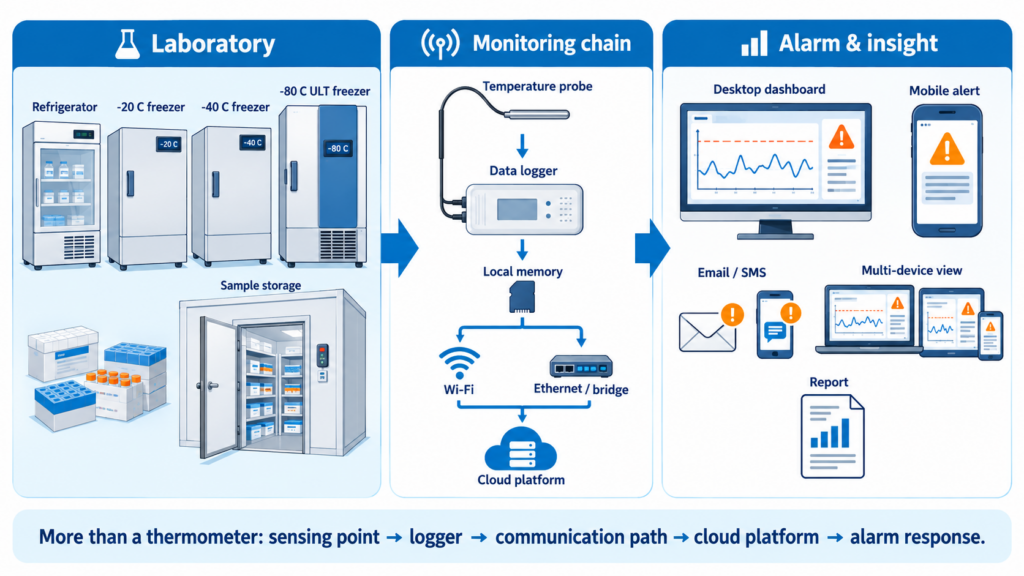
    Laboratory refrigerator and ULT freezer monitoring system with probes, local logging, cloud access and remote alerts

    A laboratory freezer monitoring system combines the sensing point, local logging, network connection, cloud visibility and alarm response into one controlled workflow.

    Who Is This Comparison For?

    This comparison is for laboratory managers, biobank and sample-storage teams, QA and QC groups, facilities engineers, clinical research operations, pharmaceutical and biotech laboratory staff, and procurement teams choosing an alarm and data-logging system for refrigerators, freezers, ultra-low-temperature freezers, and sample rooms.

    The buying trigger is often practical rather than theoretical. A freezer has warmed overnight, a door was left open, a network outage created a data gap, or an SOP audit exposed uncertainty about who receives alarms and how long records are retained. Small laboratories may need only a handful of monitored units, while larger life-science sites may need hundreds of points under common user, reporting, calibration, and change-control rules.

    The important distinction is that a laboratory remote temperature monitoring system is not just a thermometer. It is a measurement chain that includes the probe, logger, local memory, network path, cloud or server software, user permissions, alarm routing, calibration evidence, and the procedure used to respond to an excursion. That is why two products with similar headline accuracy can create very different operational burdens.

    Laboratory Refrigerator and ULT Freezer Alarm System Alerts: What Matters Most?

    Match the probe range to the real storage condition

    A refrigerator, conventional freezer, -40 C freezer, and -80 C ULT freezer are different measurement jobs. The selected probe must cover the actual setpoint and credible excursion range with margin. The logger body may not need to survive the same temperature if the probe can remain inside while the electronics stay outside. For ULT applications, this separation is especially important because batteries, displays, and Wi-Fi electronics usually have much narrower operating limits than the sensing probe.
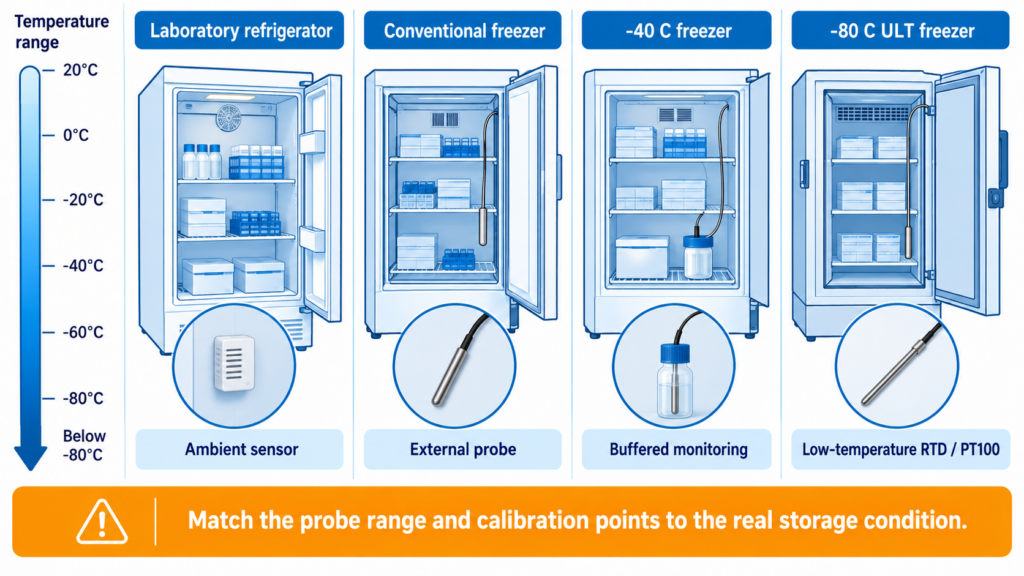
    Temperature range and probe selection for laboratory refrigerators, conventional freezers and ULT freezers

    A laboratory refrigerator, conventional freezer and -80 C ULT freezer require different sensing ranges, probe designs and calibration points.

    Do not confuse published accuracy with a validated measurement channel

    Published accuracy is a screening input, not the end of the qualification process. Buyers should review the probe type, complete logger-probe chain, calibration points, uncertainty, traceability, recalibration interval, and whether adjustments remain associated with the correct sensor serial number. In regulated work, FDA 21 CFR Part 11 and EU GMP Annex 11 can also affect how electronic records, access, audit trails, backup, and system validation are handled. A product page cannot make a customer’s configured process compliant by itself.

    Separate local data continuity from remote alarm availability

    Local storage protects the historical record when communication is interrupted. Remote alarms protect the material while an event is still developing. Those are different controls. A logger can continue recording perfectly during a network failure while being unable to reach the cloud. Commissioning should therefore test local buffering, timestamp continuity, reconnection behavior, offline alerts, and the escalation path that reaches people after hours.
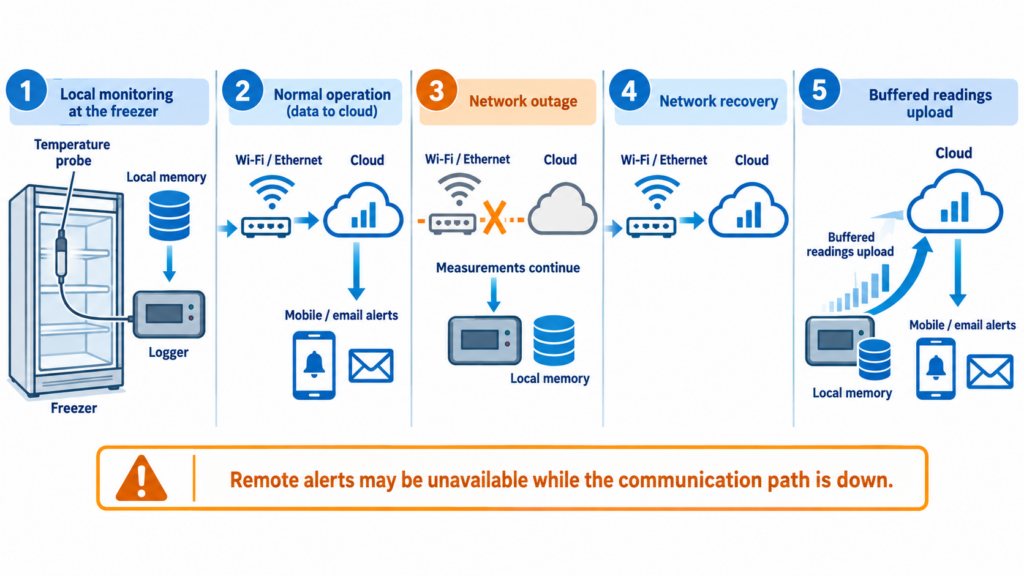
    Local data logging and remote alert availability during a laboratory freezer network outage

    Local memory can preserve the temperature record during a network outage, but remote alerts still require a working communication path.

    Choose network architecture around the laboratory, not around marketing labels

    The exact products compared here use three different approaches. UbiBot GS1-AETH1RS and Dickson DWE2 connect directly through Wi-Fi or Ethernet. Monnit Next Wi-Fi Low Temperature Sensor connects directly through Wi-Fi. ELPRO ECOLOG-PRO 1NTR uses local 868/915/922 MHz radio to an ECOLOG-PRO RBR bridge, and the bridge then uses Ethernet or PoE. None of these exact configurations includes built-in cellular connectivity, so a site with neither usable Wi-Fi nor Ethernet would need a different model or separate network path.

    Probe placement should represent the stored material, not the easiest mounting point

    Placing a sensor beside a door, against an evaporator outlet, or next to a heater can exaggerate short air-temperature swings. Placing it in a stagnant corner can miss a developing warm zone. For refrigerators and freezers, the monitoring position should be selected from mapping, equipment behavior, stored material, and SOP requirements. Buffered probes may be useful where the goal is to approximate product temperature rather than fast-moving air, but that choice must be intentional and documented.
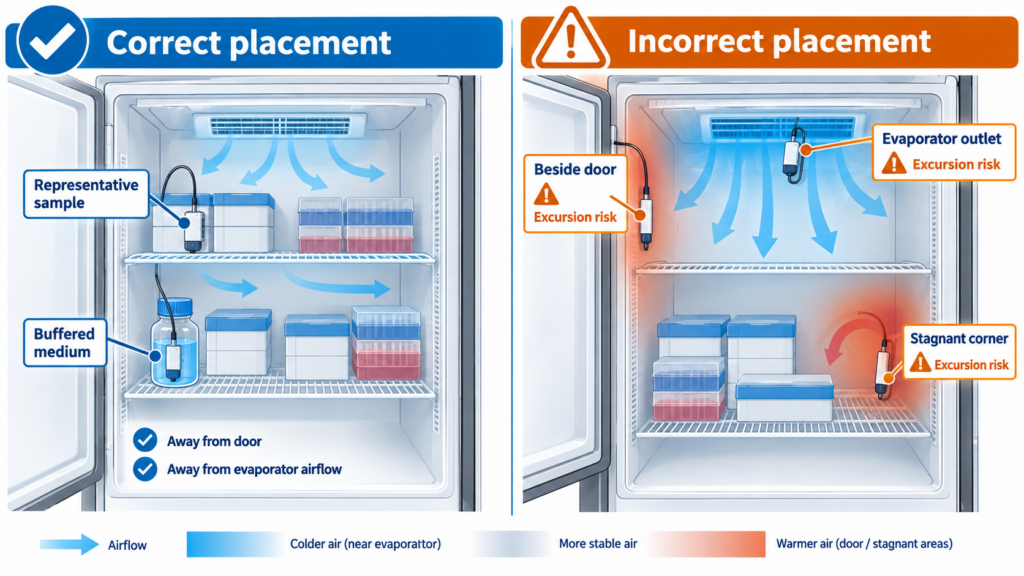
    Correct and incorrect temperature probe placement inside a laboratory refrigerator and ULT freezer

    Probe placement should represent stored samples and product temperature behavior, not short air-temperature swings near doors, vents or evaporators.

    Alarm design must include ownership and escalation

    An alert icon on a product page does not define an effective alarm system. The facility needs warning and critical limits, delays that do not hide real failures, repeat rules, primary and backup recipients, acknowledgement expectations, and a documented action when nobody responds. Power loss, low battery, device offline, probe fault, and door-open events may need different routing from a temperature excursion.

    Product Overview

    UbiBot GS1-AETH1RS

    UbiBot GS1-AETH1RS is a direct-network environmental monitor with 2.4 GHz Wi-Fi and RJ45 Ethernet, a 4-inch LCD, internal temperature/humidity/light sensing, and local memory for 300,000 records. It supports Type-C or DC power and optional PoE through a splitter. For refrigerator or freezer work, the important feature is its RS485 external-probe support. UbiBot lists a PT100 probe with a -200 C to 400 C range, which covers ULT temperatures, although the published probe accuracy is +/- (2% + 1 C), so a buyer should confirm that the complete calibrated channel meets the laboratory’s acceptance criteria. The basic UbiBot cloud tier does not require a subscription and the platform supports alerts, exports, and RESTful APIs. The exact GS1-AETH1RS is Ethernet/Wi-Fi, not 4G.

    Monnit Next Wi-Fi Low Temperature Sensor MNS2-NXT-TS-LT-L03

    Monnit’s exact low-temperature model is purpose-built for ultracold measurement. Its 3-foot waterproof probe uses a glass-coated platinum RTD and is specified from -200 C to 0 C. The data sheet lists standard accuracy of +/-1 C at 0 C and calibrated accuracy of +/-0.5 C at 0 C, with a temperature-specific table showing larger errors at colder points; at -80 C the calibrated-sensor figure is +/-0.9 C. The sensor uses 802.11b/g/n Wi-Fi, stores up to 4,096 readings during Wi-Fi loss, and runs on two replaceable AA batteries. Free iMonnit Basic provides monitoring and alert configuration, while API access requires Premiere or Enterprise.

    ELPRO ECOLOG-PRO 1NTR + ECOLOG-PRO RBR

    ECOLOG-PRO 1NTR is a wireless logger with an internal NTC sensor for rooms, refrigerators, and freezers. With the appropriate LiFe batteries its published range is -35 C to +50 C, so the exact 1NTR should not be presented as an -80 C ULT sensor. It stores 14,800 values, is rated IP67, and has a stated battery life up to 14 months under specified conditions. The logger communicates over local 868/915/922 MHz radio to an ECOLOG-PRO RBR; the bridge then connects by Ethernet and can use PoE. ELPRO positions ECOLOG-PRO with elproCLOUD or elproMONITOR for GxP-regulated facilities and publishes audit-trail, user-management, calibration, qualification, and validation-oriented services. That governance is the main reason to consider it despite the added bridge and software structure.

    Dickson DWE2

    Dickson DWE2 is a Wi-Fi/Ethernet display logger with replaceable sensors, a local LCD, audible alarms, approximately 400,000 backup sample points, and an average 72-hour battery backup. DicksonOne is required for correct cloud operation. The logger itself does not define the freezer range; the selected replaceable sensor does. For refrigerators and conventional freezers, Dickson’s RTHM glycol thermistor sensor is specified from -50 C to 70 C at +/-0.5 C across that range. For ULT work, the RRTD platinum RTD sensor is specified from -100 C to 176 C at +/-0.3 C. This replaceable-sensor model is attractive when a lab wants to swap calibrated sensors without replacing the whole logger, but the exact sensor and calibration package must be named in the purchasing specification.

    Side-by-Side Comparison Table

    Specifications below are based on current official manufacturer pages and data sheets reviewed in September 2026. Where performance depends on a replaceable probe, software tier, battery chemistry, calibration option or regional service, the dependency is stated rather than converted into a universal value.

    Comparison item UbiBot GS1-AETH1RS Monnit Next Wi-Fi Low Temp ELPRO 1NTR + RBR Dickson DWE2
    Product positioning Direct Wi-Fi/Ethernet multiparameter monitor with RS485 probe expansion Direct Wi-Fi ULT temperature sensor with external RTD probe Wireless GxP-oriented refrigerator/freezer logger plus radio bridge Direct Wi-Fi/Ethernet cloud logger with replaceable sensors
    Primary lab use General lab rooms, refrigerators/freezers; ULT only with suitable external probe and approved accuracy Dedicated ULT and low-temperature freezer monitoring Regulated rooms, refrigerators and standard freezers Refrigerators/freezers; ULT with an appropriate RTD or thermocouple sensor
    Measurement parameters Internal temperature, RH, light; external RS485 parameters depend on probe Temperature only Temperature only Depends on sensor; temperature, T/RH, pressure and other options
    Key range for freezer use PT100 option: -200 C to 400 C; internal sensor: -20 C to 60 C -200 C to 0 C 1NTR: -35 C to +50 C with LiFe batteries RTHM: -50 C to 70 C; RRTD: -100 C to 176 C
    Published accuracy Internal: temp +/-0.2 C, RH +/-2%; PT100: +/- (2% + 1 C) At 0 C: +/-1 C standard, +/-0.5 C calibrated; calibrated table: +/-0.9 C at -80 C +/-1.0 C from -35 to -10.1 C; +/-0.5 C -10 to -0.1 C; +/-0.4 C 0 to 25 C; +/-0.8 C above 25 C RTHM: +/-0.5 C; RRTD: +/-0.3 C in published range
    Connectivity 2.4 GHz Wi-Fi + RJ45 Ethernet 802.11b/g/n Wi-Fi 868/915/922 MHz to RBR; RBR uses Ethernet 2.4 GHz Wi-Fi or Ethernet
    External probe support RS485 probes including PT100; exact combinations must be confirmed Integrated 3-ft leaded waterproof low-temp RTD probe No external probe on 1NTR; internal NTC Replaceable sensor system; exact freezer sensor selected separately
    Gateway requirement No separate gateway No separate gateway ECOLOG-PRO RBR required No separate gateway
    Local display 4-inch LCD Status LED; no numeric display listed on exact sensor page Three status LEDs; no numeric display LCD with current/min/max values
    Power Internal lithium battery, Type-C, DC 5-12 V, optional PoE splitter 2 x AA; lithium recommended for longer life 2 x AAA; LiFe for freezer range; up to 14 months stated 12 VDC with average 72-hour battery backup
    Local data storage 300,000 sensing records Up to 4,096 readings during Wi-Fi loss 14,800 measurements Approx. 400,000 backup sample points
    Cloud/software UbiBot public IoT platform; free basic allowance iMonnit Basic or paid tiers elproCLOUD or elproMONITOR DicksonOne
    Alerts App, email, web; SMS/voice available with credits; offline alerts supported Email/push; direct SMS and voice can be paid depending on setup Email/SMS through ELPRO software Phone, SMS, email and audible alarms
    API/integration RESTful API and data forwarding available REST/webhook APIs require Premiere or Enterprise Optional API / enterprise integration depending on ELPRO software Not publicly specified on the exact DWE2 product page; confirm DicksonOne entitlement
    Subscription requirement No mandatory subscription for basic public cloud; paid capacity/services can apply Free Basic available; paid Premiere/Enterprise for broader features and API Software/license structure applies; obtain current ELPRO commercial terms DicksonOne subscription required
    Best suited for Pilot labs, ancillary spaces and mixed sites that value Ethernet, local display, probe flexibility and lower base software burden Dedicated ULT freezers where a purpose-built -200 C to 0 C probe and direct Wi-Fi are attractive GxP-oriented refrigerator/freezer programmes needing strong software governance and validation support Labs that value local alarms, battery backup and replaceable calibrated sensors
    Key limitation Exact model has no 4G; PT100 accuracy/complete-channel calibration must meet the ULT acceptance criterion Wi-Fi only; board electronics and batteries should remain within their own operating limits Exact 1NTR lower limit is -35 C, so it does not cover typical -80 C ULT storage Subscription required; performance and range depend on the exact replaceable sensor

    Connectivity and Deployment Comparison
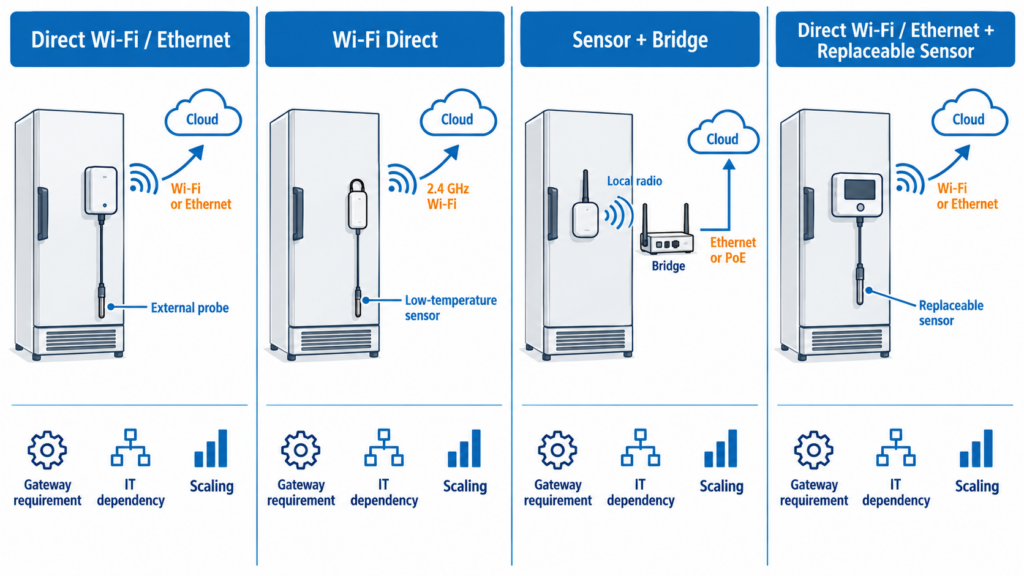
    Comparison of Wi-Fi, Ethernet and bridge-based connectivity for laboratory refrigerator and ULT freezer monitoring systems

    The four systems differ most clearly in how each sensing point reaches the network: direct Wi-Fi/Ethernet, Wi-Fi-only, or local radio through a bridge.

    The connectivity comparison is simpler than it first appears. UbiBot GS1-AETH1RS and Dickson DWE2 are the two exact products here that offer both Wi-Fi and Ethernet. That matters in laboratories because refrigerator rooms, equipment corridors, basements, and dense instrument areas can have poor wireless coverage even when the building network is reliable. Ethernet also gives IT teams a more predictable path for fixed equipment, and UbiBot’s optional PoE splitter can reduce the number of power adapters at an installation point.

    Monnit Next Wi-Fi Low Temperature Sensor is the lowest-infrastructure ULT option when 2.4 GHz Wi-Fi is already proven at the freezer. It connects directly to the WLAN and iMonnit, without a gateway. The trade-off is architectural concentration: if Wi-Fi disappears, the sensor can keep logging up to 4,096 readings, but remote visibility and cloud alerts stop until connectivity returns. That is acceptable only if the outage procedure and local response plan account for it.

    ELPRO uses a local-radio architecture instead. 1NTR sensors communicate to the RBR, and one RBR can connect up to 50 sensors. The bridge then connects to the software through Ethernet. This adds hardware and configuration at low point counts, but it can be operationally cleaner in large regulated labs because individual loggers do not each need WLAN credentials. It also creates a natural place to manage local radio coverage and bridge redundancy.

    A critical clarification for the search intent behind this article is that none of the four exact configurations provides built-in cellular backhaul. The attached brief mentions independent connectivity and alarms without site Wi-Fi, but the selected UbiBot model is GS1-AETH1RS, which is Wi-Fi/Ethernet rather than 4G. If a facility truly has no usable Wi-Fi or Ethernet, the procurement team should evaluate a cellular-capable model or an external router rather than attributing 4G capability to this exact logger.

    Sensor and External Probe Comparison

    ULT monitoring is where the product differences become most meaningful. The Monnit sensor is purpose-built around an external low-temperature RTD probe. The probe can sit inside the freezer while the Wi-Fi electronics remain outside the extreme-cold space. This is a sensible architecture because the sensor board is specified for a much narrower temperature range than the probe itself. At -80 C, buyers should use the accuracy table rather than the simpler 0 C headline figure.

    UbiBot takes a more general platform approach. The GS1 body can monitor room temperature, humidity and light, while an RS485 probe handles a different location or range. The UbiBot PT100 range covers ultracold temperatures, but range alone is not enough: its published accuracy is broader than the figures published for the dedicated Monnit low-temperature probe or Dickson RRTD. For an ULT freezer, the laboratory should therefore define the allowable system uncertainty and calibration points before deciding that the GS1/PT100 combination is suitable.

    Dickson’s sensor-swapping model is particularly useful for life-science operations. The RTHM glycol thermistor is designed for refrigerators or freezers and dampens short air-temperature changes. For -80 C applications, Dickson itself recommends an RTD-type solution rather than the glycol thermistor. Pairing DWE2 with the appropriate RRTD sensor gives a range down to -100 C and published accuracy of +/-0.3 C. The procurement document should name the exact sensor SKU because ‘DWE2’ by itself does not define the measurement performance.

    ELPRO 1NTR uses an internal NTC sensor and is designed to be placed directly in the monitored space. That simplicity is useful in refrigerators and standard freezers down to -35 C with the specified battery type. It is not the correct exact logger for a typical -80 C ULT freezer. ELPRO offers other modules, such as PT100-based ECOLOG-PRO options, but those are outside this comparison and should not be used to inflate the capability of 1NTR.

    Cloud Platform, Alerts and Data Management
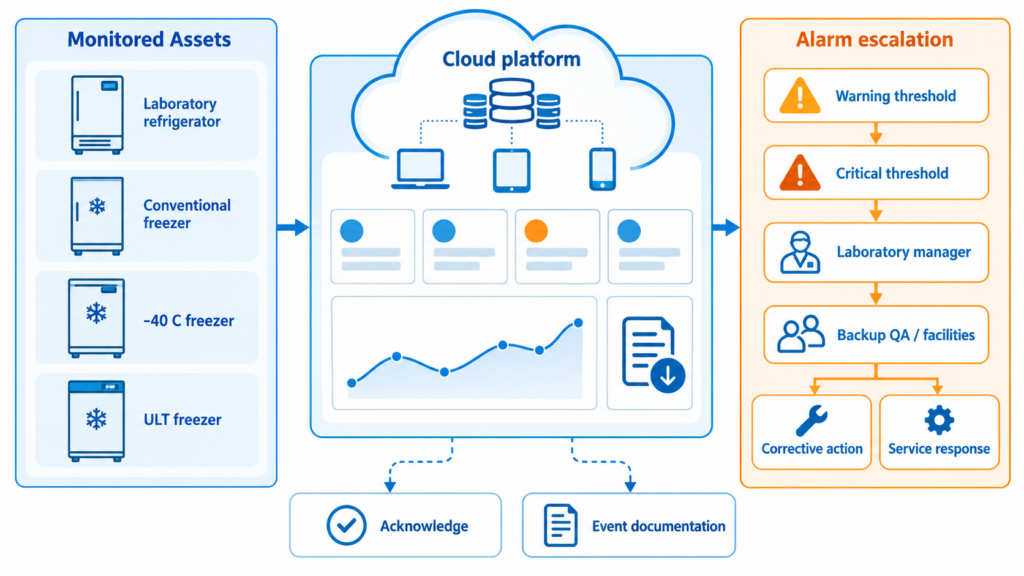
    Laboratory freezer cloud monitoring, multi-device dashboard and alarm escalation workflow

    An effective laboratory freezer alarm workflow defines thresholds, recipients, escalation and corrective action – not just a notification channel.

    For a small laboratory, UbiBot’s cloud model is the least demanding commercially. The GS1-AETH1RS includes a free basic cloud allowance, and UbiBot supports dashboards, historical data, sharing, exports, configurable alerts, RESTful APIs and data forwarding. App, email and web notifications can be used without the organization buying a separate enterprise software package, while SMS and voice use credits. That makes the system attractive for pilot labs and ancillary spaces, but regulated users still need to assess access controls, retention, audit evidence, backup and validation against their own quality system.

    Monnit’s iMonnit provides online data, rules and notifications, with a free Basic tier. The low-temperature sensor’s main advantage is that the sensor and Wi-Fi path are simple. More sophisticated integration changes the economics: Monnit states that REST and webhook APIs require iMonnit Premiere or Enterprise. Direct SMS and voice can also be paid features, so teams should price the notification model actually used rather than assuming all alert channels are free.

    ELPRO is the most explicitly validation-oriented software proposition in the comparison. ELPRO positions ECOLOG-PRO with elproCLOUD and elproMONITOR for GxP environments and publishes audit-trail, user-management, alarm, qualification, calibration and validation support. That is a meaningful advantage for organizations that want a vendor ecosystem built around regulated monitoring. It does not remove the customer’s responsibilities for intended-use validation, SOPs, role design, backup, change control and periodic review.

    DicksonOne is mandatory for DWE2’s intended cloud workflow. The combination supports remote access, multi-location monitoring, email/SMS/phone alarms, and a local audible alarm at the logger. The local 72-hour battery backup and large backup memory are valuable because they address two failure modes that cloud-only thinking can overlook: loss of mains power and loss of network transmission. Buyers should still verify the current subscription tier, retention, report functions, user permissions and validation documentation required for the project.

    Total Deployment Cost and Recurring Burden
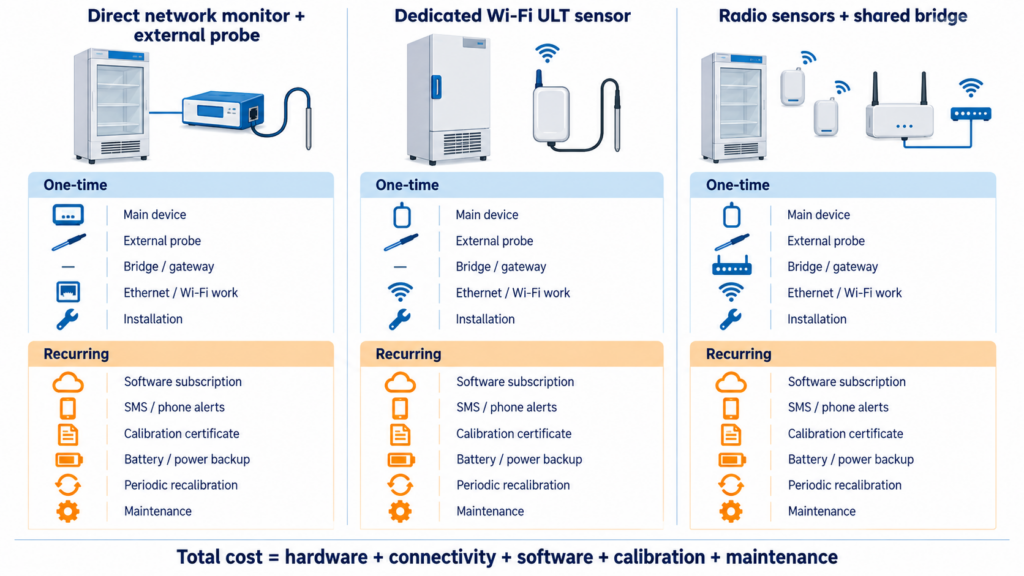
    Lifecycle cost components for laboratory refrigerator and ULT freezer monitoring systems

    Lifecycle cost depends on more than the logger price: probes, bridges, software, calibration, networking and maintenance all change the deployment model.

    The cheapest device is not necessarily the lowest-cost system. A defensible comparison should include the base logger, external probe, calibration, network work, mounting, gateway or bridge, cloud subscription, alert credits, replacement batteries, spare sensors, periodic verification, validation work, and the labor required when a freezer or sensor is serviced.

    UbiBot usually has the lightest recurring software structure because the basic public cloud is not subscription-gated. Its costs shift toward the exact external probe, PoE or power accessories, calibration, paid messaging, API or storage upgrades, and the laboratory’s own validation effort. Monnit’s exact Next Wi-Fi ULT sensor avoids a gateway, but paid software or API features can add cost and Wi-Fi quality must be adequate at every freezer.

    ELPRO has the heaviest architecture at a very small point count because the RBR and software/service model sit above the sensor. At scale, however, one bridge supporting many sensors can be a rational design, particularly when governance, qualification, and common procedures matter more than the lowest hardware cost. Dickson sits between those models: DWE2 does not need a gateway, but the selected replaceable sensor, calibration option, DicksonOne subscription, and periodic sensor replacement should all be included in the lifecycle estimate.

    For a multi-year budget, model at least three scenarios: one pilot freezer, a 10- to 20-unit laboratory, and a multi-room site. Also include the cost of missed alarms and truck-roll equivalents inside the building, such as after-hours technician callouts or sample-disposition investigations. Those operational costs can be larger than the software fee that initially dominates the purchasing discussion.

    Brand-by-Brand Strengths and Trade-Offs

    UbiBot GS1-AETH1RS

    UbiBot is strongest for pilot labs, support spaces and mixed monitoring estates where Ethernet plus Wi-Fi, a local screen, large local memory, RS485 expansion, API access and a low mandatory software burden are valuable. The same platform can also monitor ambient rooms around the freezers. The trade-off is that the exact AETH1RS model has no cellular path and its PT100 accuracy specification requires careful review for ULT acceptance. For a high-value -80 C archive, range alone should not be treated as proof of fitness.

    Monnit Next Wi-Fi Low Temperature Sensor

    Monnit is the most straightforward dedicated ULT sensor in the exact set. The -200 C to 0 C probe, temperature-specific accuracy table, local Wi-Fi-loss buffer, replaceable batteries and direct connection to iMonnit make it easy to understand. It is less attractive where laboratory Wi-Fi is restricted or unstable, where a local numerical display is required, or where enterprise API access is needed without a paid software tier.

    ELPRO ECOLOG-PRO 1NTR + RBR

    ELPRO is strongest for regulated refrigerator and standard-freezer programmes that value a GxP-oriented ecosystem, common governance, calibration and qualification services, and scalable local radio. The exact 1NTR is rugged and self-contained, but the -35 C lower limit excludes typical -80 C ULT service. The bridge and software structure also add cost and implementation work at low point counts.

    Dickson DWE2

    Dickson best fits labs that want direct Ethernet/Wi-Fi, clear local min/max visibility, an audible alarm, long backup storage, battery backup and replaceable calibrated sensors. It also gives the buyer a credible path from normal refrigerator monitoring with a glycol thermistor to ULT monitoring with an RTD. The trade-offs are the required DicksonOne subscription, an IP21 base logger that should remain protected, and the need to specify the exact sensor rather than buying DWE2 as if it had one universal range.

    Which Product Should You Choose?
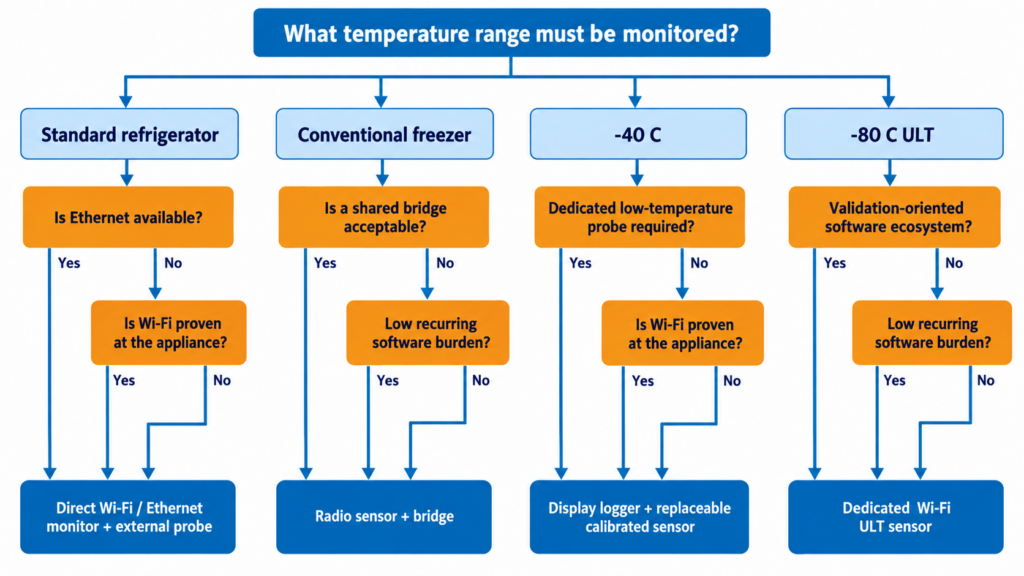
    Decision guide for choosing a laboratory refrigerator or ULT freezer temperature monitoring system

    The right system depends first on the storage temperature, then on connectivity, validation needs, probe architecture and long-term operating model.

    Choose this product When this purchasing condition matters most
    Choose UbiBot GS1-AETH1RS You need Ethernet or Wi-Fi, a local display, large local memory, optional PoE, RS485 expansion and lower mandatory software burden. For ULT use, you are prepared to qualify the selected PT100 channel against your required uncertainty.
    Choose Monnit Next Wi-Fi Low Temperature Sensor You need a purpose-built -200 C to 0 C probe for ULT freezers, direct Wi-Fi, local buffering and a relatively simple per-freezer architecture.
    Choose ELPRO ECOLOG-PRO 1NTR + RBR You are monitoring refrigerators or standard freezers above -35 C and prioritize a GxP-oriented software, qualification and governance ecosystem across many points.
    Choose Dickson DWE2 You want local audible alarms, a 72-hour battery backup, large backup memory, Wi-Fi/Ethernet and replaceable calibrated sensors, including an RTD option for ULT temperatures.

    Pros and Cons

    Choose this product When this purchasing condition matters most
    Choose UbiBot GS1-AETH1RS You need Ethernet or Wi-Fi, a local display, large local memory, optional PoE, RS485 expansion and lower mandatory software burden. For ULT use, you are prepared to qualify the selected PT100 channel against your required uncertainty.
    Choose Monnit Next Wi-Fi Low Temperature Sensor You need a purpose-built -200 C to 0 C probe for ULT freezers, direct Wi-Fi, local buffering and a relatively simple per-freezer architecture.
    Choose ELPRO ECOLOG-PRO 1NTR + RBR You are monitoring refrigerators or standard freezers above -35 C and prioritize a GxP-oriented software, qualification and governance ecosystem across many points.
    Choose Dickson DWE2 You want local audible alarms, a 72-hour battery backup, large backup memory, Wi-Fi/Ethernet and replaceable calibrated sensors, including an RTD option for ULT temperatures.

    Frequently Asked Questions

    Which monitor is best for an -80 C ULT freezer?

    Among the exact products compared, Monnit Next Wi-Fi Low Temperature Sensor is the most purpose-built ULT option because its probe is specified from -200 C to 0 C. Dickson DWE2 can also be a strong ULT system when paired with the RRTD platinum RTD sensor. UbiBot’s PT100 range covers -80 C, but the laboratory should confirm whether its published accuracy and calibrated system uncertainty meet the acceptance criteria. ELPRO 1NTR does not cover -80 C.

    Does UbiBot GS1-AETH1RS require a gateway?

    No. It connects directly by 2.4 GHz Wi-Fi or RJ45 Ethernet. External RS485 probes connect to the GS1, subject to the supported model and port configuration.

    Can these systems send remote alerts without Wi-Fi?

    UbiBot GS1-AETH1RS and Dickson DWE2 can use Ethernet instead of Wi-Fi. ELPRO sensors use local radio to an RBR, and the RBR uses Ethernet. The exact Monnit Next low-temperature sensor is Wi-Fi based. None of these exact configurations includes built-in cellular backhaul, so a site with no usable Wi-Fi or Ethernet needs another network path or a different model.

    Can the probe stay inside the freezer while the logger stays outside?

    Yes for probe-based configurations such as the Monnit low-temperature sensor, UbiBot GS1 with an external PT100, and Dickson with a compatible external sensor. ELPRO 1NTR uses an internal probe, so the logger itself is placed in the monitored refrigerator or freezer within its operating range.

    Is a cloud subscription required?

    UbiBot provides a free basic cloud allowance and does not require a subscription for that base tier. Monnit provides iMonnit Basic with paid upgrades for broader features and APIs. DicksonOne is required for DWE2’s intended cloud workflow. ELPRO uses elproCLOUD or elproMONITOR under its own license and service structure.

    Can multiple refrigerators and freezers be managed from one account?

    Yes, all four vendors support multi-device or multi-location management in some form. The practical limits, user roles, retention, audit trail, API access and pricing depend on the selected software plan and architecture.

    Are these systems automatically compliant with 21 CFR Part 11 or GMP requirements?

    No. A monitoring device is one component of a controlled system. ELPRO explicitly markets ECOLOG-PRO and its software for GxP and Part 11 workflows, but the customer still has to confirm the exact version, intended use, validation evidence, access controls, audit trail, backup, SOPs, calibration and change control. The same principle applies to every vendor.

    Which option is easiest to deploy in a small laboratory?

    For standard refrigerators and rooms with Ethernet or reliable Wi-Fi, UbiBot GS1-AETH1RS is simple because it needs no gateway and the basic cloud is not subscription-gated. For a dedicated ULT freezer with proven Wi-Fi, Monnit’s Next low-temperature sensor is also straightforward. ELPRO adds an RBR and validation-oriented structure; Dickson adds a required cloud subscription but offers useful local alarm and backup features.

    Final Verdict

    There is no single winner across laboratory refrigerators, conventional freezers and -80 C ULT freezers. The temperature range alone changes the shortlist. For general laboratory cold storage where Ethernet or Wi-Fi already exists, UbiBot GS1-AETH1RS is a balanced, low-overhead platform with strong local storage, a useful display, PoE flexibility, RS485 expansion, cloud alerts and a free basic tier. It is especially attractive for pilots, ancillary spaces and cost-sensitive multi-site rollouts.

    For ULT storage, the dedicated sensor matters more than brand breadth. Monnit’s exact Next Wi-Fi Low Temperature Sensor is the clearest out-of-the-box low-temperature match. Dickson DWE2 paired with the correct RRTD sensor is stronger when local audible alarms, battery backup, replaceable calibration modules and a controlled cloud workflow are priorities. ELPRO ECOLOG-PRO 1NTR is compelling for regulated refrigerator and standard-freezer programmes, but its exact -35 C lower limit means an ELPRO ULT project should use a different ELPRO sensor architecture rather than stretching the 1NTR specification.

    Before ordering, freeze the exact logger and probe SKU, define the working and alarm ranges, approve calibration points and uncertainty, test network-loss and power-loss behavior, document recipients and escalation, and confirm software retention, user roles and validation responsibilities. A reliable laboratory refrigerator and ULT freezer alarm system is a complete operational control, not a temperature sensor connected to the internet.

    Official Sources Reviewed

    1. UbiBot GS1-AETH1RS product page: https://store.ubibot.com/products/ubibot-gs1-eth-wifi-and-ethernet-cable
    2. UbiBot GS1-AETH1RS specifications: https://store.ubibot.com/pages/ubibotgs1-aeth1rs_specifications
    3. UbiBot PT100 industrial-grade probe: https://store.ubibot.com/collections/external-probes/products/pt-100-temperature-probe
    4. UbiBot temperature probe comparison: https://www.ubibot.com/question-ws1pro/5929/ds18b20-vs-pt100-temperature-sensor/
    5. UbiBot alerts support: https://helpdesk.ubibot.com/article/how-to-setup-alerts
    6. UbiBot IoT Platform: https://www.ubibot.com/big-data-platform/
    7. UbiBot RESTful API quick start: https://www.ubibot.com/platform-api/1232/quick-start/

    Related Resources

    Monitoring of the Heating System in This Cold Winter
    Why You Should Consider Getting Remote Thermometer Sensors
    menu-header-svg
    Search
    • Explore Knowledge
      • Comparison & Selection
      • Industry Solution
      • Product & Device
      • Criterion & Compliance
      • Deployment & Usage
      • Technology & Principle
    • Academic Research
    • In-depth Tech

    Comparison & Selection

    See More >>

    UbiBot vs Monnit vs ELPRO vs Dickson: Which Is Better for Laboratory Refrigerators and ULT Freezers?

    Published: September 10, 2026

    Updated: September 10, 2026

    By Jason Fallon

    Quick Answer

    For mixed laboratory refrigerator and freezer monitoring, UbiBot GS1-AETH1RS is a practical direct-connect option when a lab already has Ethernet or reliable 2.4 GHz Wi-Fi and wants local storage, a 4-inch display, PoE flexibility, external probe support, cloud alerts, and a low mandatory software burden. For a true ultra-low-temperature freezer, however, Monnit’s Next Wi-Fi Low Temperature Sensor is the clearest exact sensor match in this comparison because its probe is specified from -200 C to 0 C. Dickson DWE2 becomes a strong ULT option when paired with an appropriate RTD sensor and is attractive where local audible alarms and a 72-hour battery backup matter. ELPRO ECOLOG-PRO 1NTR is the strongest validation-oriented architecture for regulated multi-room refrigerator and standard freezer monitoring, but its exact -35 C lower limit does not cover a typical -80 C ULT application. The deciding factors are probe range, calibration, network architecture, alarm workflow, and lifecycle cost.

    Laboratory refrigerator and ULT freezer monitoring system with probes, local logging, cloud access and remote alerts

    A laboratory freezer monitoring system combines the sensing point, local logging, network connection, cloud visibility and alarm response into one controlled workflow.

    Who Is This Comparison For?

    This comparison is for laboratory managers, biobank and sample-storage teams, QA and QC groups, facilities engineers, clinical research operations, pharmaceutical and biotech laboratory staff, and procurement teams choosing an alarm and data-logging system for refrigerators, freezers, ultra-low-temperature freezers, and sample rooms.

    The buying trigger is often practical rather than theoretical. A freezer has warmed overnight, a door was left open, a network outage created a data gap, or an SOP audit exposed uncertainty about who receives alarms and how long records are retained. Small laboratories may need only a handful of monitored units, while larger life-science sites may need hundreds of points under common user, reporting, calibration, and change-control rules.

    The important distinction is that a laboratory remote temperature monitoring system is not just a thermometer. It is a measurement chain that includes the probe, logger, local memory, network path, cloud or server software, user permissions, alarm routing, calibration evidence, and the procedure used to respond to an excursion. That is why two products with similar headline accuracy can create very different operational burdens.

    Laboratory Refrigerator and ULT Freezer Alarm System Alerts: What Matters Most?

    Match the probe range to the real storage condition

    A refrigerator, conventional freezer, -40 C freezer, and -80 C ULT freezer are different measurement jobs. The selected probe must cover the actual setpoint and credible excursion range with margin. The logger body may not need to survive the same temperature if the probe can remain inside while the electronics stay outside. For ULT applications, this separation is especially important because batteries, displays, and Wi-Fi electronics usually have much narrower operating limits than the sensing probe.

    Temperature range and probe selection for laboratory refrigerators, conventional freezers and ULT freezers

    A laboratory refrigerator, conventional freezer and -80 C ULT freezer require different sensing ranges, probe designs and calibration points.

    Do not confuse published accuracy with a validated measurement channel

    Published accuracy is a screening input, not the end of the qualification process. Buyers should review the probe type, complete logger-probe chain, calibration points, uncertainty, traceability, recalibration interval, and whether adjustments remain associated with the correct sensor serial number. In regulated work, FDA 21 CFR Part 11 and EU GMP Annex 11 can also affect how electronic records, access, audit trails, backup, and system validation are handled. A product page cannot make a customer’s configured process compliant by itself.

    Separate local data continuity from remote alarm availability

    Local storage protects the historical record when communication is interrupted. Remote alarms protect the material while an event is still developing. Those are different controls. A logger can continue recording perfectly during a network failure while being unable to reach the cloud. Commissioning should therefore test local buffering, timestamp continuity, reconnection behavior, offline alerts, and the escalation path that reaches people after hours.

    Local data logging and remote alert availability during a laboratory freezer network outage

    Local memory can preserve the temperature record during a network outage, but remote alerts still require a working communication path.

    Choose network architecture around the laboratory, not around marketing labels

    The exact products compared here use three different approaches. UbiBot GS1-AETH1RS and Dickson DWE2 connect directly through Wi-Fi or Ethernet. Monnit Next Wi-Fi Low Temperature Sensor connects directly through Wi-Fi. ELPRO ECOLOG-PRO 1NTR uses local 868/915/922 MHz radio to an ECOLOG-PRO RBR bridge, and the bridge then uses Ethernet or PoE. None of these exact configurations includes built-in cellular connectivity, so a site with neither usable Wi-Fi nor Ethernet would need a different model or separate network path.

    Probe placement should represent the stored material, not the easiest mounting point

    Placing a sensor beside a door, against an evaporator outlet, or next to a heater can exaggerate short air-temperature swings. Placing it in a stagnant corner can miss a developing warm zone. For refrigerators and freezers, the monitoring position should be selected from mapping, equipment behavior, stored material, and SOP requirements. Buffered probes may be useful where the goal is to approximate product temperature rather than fast-moving air, but that choice must be intentional and documented.

    Correct and incorrect temperature probe placement inside a laboratory refrigerator and ULT freezer

    Probe placement should represent stored samples and product temperature behavior, not short air-temperature swings near doors, vents or evaporators.

    Alarm design must include ownership and escalation

    An alert icon on a product page does not define an effective alarm system. The facility needs warning and critical limits, delays that do not hide real failures, repeat rules, primary and backup recipients, acknowledgement expectations, and a documented action when nobody responds. Power loss, low battery, device offline, probe fault, and door-open events may need different routing from a temperature excursion.

    Product Overview

    UbiBot GS1-AETH1RS

    UbiBot GS1-AETH1RS is a direct-network environmental monitor with 2.4 GHz Wi-Fi and RJ45 Ethernet, a 4-inch LCD, internal temperature/humidity/light sensing, and local memory for 300,000 records. It supports Type-C or DC power and optional PoE through a splitter. For refrigerator or freezer work, the important feature is its RS485 external-probe support. UbiBot lists a PT100 probe with a -200 C to 400 C range, which covers ULT temperatures, although the published probe accuracy is +/- (2% + 1 C), so a buyer should confirm that the complete calibrated channel meets the laboratory’s acceptance criteria. The basic UbiBot cloud tier does not require a subscription and the platform supports alerts, exports, and RESTful APIs. The exact GS1-AETH1RS is Ethernet/Wi-Fi, not 4G.

    Monnit Next Wi-Fi Low Temperature Sensor MNS2-NXT-TS-LT-L03

    Monnit’s exact low-temperature model is purpose-built for ultracold measurement. Its 3-foot waterproof probe uses a glass-coated platinum RTD and is specified from -200 C to 0 C. The data sheet lists standard accuracy of +/-1 C at 0 C and calibrated accuracy of +/-0.5 C at 0 C, with a temperature-specific table showing larger errors at colder points; at -80 C the calibrated-sensor figure is +/-0.9 C. The sensor uses 802.11b/g/n Wi-Fi, stores up to 4,096 readings during Wi-Fi loss, and runs on two replaceable AA batteries. Free iMonnit Basic provides monitoring and alert configuration, while API access requires Premiere or Enterprise.

    ELPRO ECOLOG-PRO 1NTR + ECOLOG-PRO RBR

    ECOLOG-PRO 1NTR is a wireless logger with an internal NTC sensor for rooms, refrigerators, and freezers. With the appropriate LiFe batteries its published range is -35 C to +50 C, so the exact 1NTR should not be presented as an -80 C ULT sensor. It stores 14,800 values, is rated IP67, and has a stated battery life up to 14 months under specified conditions. The logger communicates over local 868/915/922 MHz radio to an ECOLOG-PRO RBR; the bridge then connects by Ethernet and can use PoE. ELPRO positions ECOLOG-PRO with elproCLOUD or elproMONITOR for GxP-regulated facilities and publishes audit-trail, user-management, calibration, qualification, and validation-oriented services. That governance is the main reason to consider it despite the added bridge and software structure.

    Dickson DWE2

    Dickson DWE2 is a Wi-Fi/Ethernet display logger with replaceable sensors, a local LCD, audible alarms, approximately 400,000 backup sample points, and an average 72-hour battery backup. DicksonOne is required for correct cloud operation. The logger itself does not define the freezer range; the selected replaceable sensor does. For refrigerators and conventional freezers, Dickson’s RTHM glycol thermistor sensor is specified from -50 C to 70 C at +/-0.5 C across that range. For ULT work, the RRTD platinum RTD sensor is specified from -100 C to 176 C at +/-0.3 C. This replaceable-sensor model is attractive when a lab wants to swap calibrated sensors without replacing the whole logger, but the exact sensor and calibration package must be named in the purchasing specification.

    Side-by-Side Comparison Table

    Specifications below are based on current official manufacturer pages and data sheets reviewed in September 2026. Where performance depends on a replaceable probe, software tier, battery chemistry, calibration option or regional service, the dependency is stated rather than converted into a universal value.

    Comparison item UbiBot GS1-AETH1RS Monnit Next Wi-Fi Low Temp ELPRO 1NTR + RBR Dickson DWE2
    Product positioning Direct Wi-Fi/Ethernet multiparameter monitor with RS485 probe expansion Direct Wi-Fi ULT temperature sensor with external RTD probe Wireless GxP-oriented refrigerator/freezer logger plus radio bridge Direct Wi-Fi/Ethernet cloud logger with replaceable sensors
    Primary lab use General lab rooms, refrigerators/freezers; ULT only with suitable external probe and approved accuracy Dedicated ULT and low-temperature freezer monitoring Regulated rooms, refrigerators and standard freezers Refrigerators/freezers; ULT with an appropriate RTD or thermocouple sensor
    Measurement parameters Internal temperature, RH, light; external RS485 parameters depend on probe Temperature only Temperature only Depends on sensor; temperature, T/RH, pressure and other options
    Key range for freezer use PT100 option: -200 C to 400 C; internal sensor: -20 C to 60 C -200 C to 0 C 1NTR: -35 C to +50 C with LiFe batteries RTHM: -50 C to 70 C; RRTD: -100 C to 176 C
    Published accuracy Internal: temp +/-0.2 C, RH +/-2%; PT100: +/- (2% + 1 C) At 0 C: +/-1 C standard, +/-0.5 C calibrated; calibrated table: +/-0.9 C at -80 C +/-1.0 C from -35 to -10.1 C; +/-0.5 C -10 to -0.1 C; +/-0.4 C 0 to 25 C; +/-0.8 C above 25 C RTHM: +/-0.5 C; RRTD: +/-0.3 C in published range
    Connectivity 2.4 GHz Wi-Fi + RJ45 Ethernet 802.11b/g/n Wi-Fi 868/915/922 MHz to RBR; RBR uses Ethernet 2.4 GHz Wi-Fi or Ethernet
    External probe support RS485 probes including PT100; exact combinations must be confirmed Integrated 3-ft leaded waterproof low-temp RTD probe No external probe on 1NTR; internal NTC Replaceable sensor system; exact freezer sensor selected separately
    Gateway requirement No separate gateway No separate gateway ECOLOG-PRO RBR required No separate gateway
    Local display 4-inch LCD Status LED; no numeric display listed on exact sensor page Three status LEDs; no numeric display LCD with current/min/max values
    Power Internal lithium battery, Type-C, DC 5-12 V, optional PoE splitter 2 x AA; lithium recommended for longer life 2 x AAA; LiFe for freezer range; up to 14 months stated 12 VDC with average 72-hour battery backup
    Local data storage 300,000 sensing records Up to 4,096 readings during Wi-Fi loss 14,800 measurements Approx. 400,000 backup sample points
    Cloud/software UbiBot public IoT platform; free basic allowance iMonnit Basic or paid tiers elproCLOUD or elproMONITOR DicksonOne
    Alerts App, email, web; SMS/voice available with credits; offline alerts supported Email/push; direct SMS and voice can be paid depending on setup Email/SMS through ELPRO software Phone, SMS, email and audible alarms
    API/integration RESTful API and data forwarding available REST/webhook APIs require Premiere or Enterprise Optional API / enterprise integration depending on ELPRO software Not publicly specified on the exact DWE2 product page; confirm DicksonOne entitlement
    Subscription requirement No mandatory subscription for basic public cloud; paid capacity/services can apply Free Basic available; paid Premiere/Enterprise for broader features and API Software/license structure applies; obtain current ELPRO commercial terms DicksonOne subscription required
    Best suited for Pilot labs, ancillary spaces and mixed sites that value Ethernet, local display, probe flexibility and lower base software burden Dedicated ULT freezers where a purpose-built -200 C to 0 C probe and direct Wi-Fi are attractive GxP-oriented refrigerator/freezer programmes needing strong software governance and validation support Labs that value local alarms, battery backup and replaceable calibrated sensors
    Key limitation Exact model has no 4G; PT100 accuracy/complete-channel calibration must meet the ULT acceptance criterion Wi-Fi only; board electronics and batteries should remain within their own operating limits Exact 1NTR lower limit is -35 C, so it does not cover typical -80 C ULT storage Subscription required; performance and range depend on the exact replaceable sensor

    Connectivity and Deployment Comparison

    Comparison of Wi-Fi, Ethernet and bridge-based connectivity for laboratory refrigerator and ULT freezer monitoring systems

    The four systems differ most clearly in how each sensing point reaches the network: direct Wi-Fi/Ethernet, Wi-Fi-only, or local radio through a bridge.

    The connectivity comparison is simpler than it first appears. UbiBot GS1-AETH1RS and Dickson DWE2 are the two exact products here that offer both Wi-Fi and Ethernet. That matters in laboratories because refrigerator rooms, equipment corridors, basements, and dense instrument areas can have poor wireless coverage even when the building network is reliable. Ethernet also gives IT teams a more predictable path for fixed equipment, and UbiBot’s optional PoE splitter can reduce the number of power adapters at an installation point.

    Monnit Next Wi-Fi Low Temperature Sensor is the lowest-infrastructure ULT option when 2.4 GHz Wi-Fi is already proven at the freezer. It connects directly to the WLAN and iMonnit, without a gateway. The trade-off is architectural concentration: if Wi-Fi disappears, the sensor can keep logging up to 4,096 readings, but remote visibility and cloud alerts stop until connectivity returns. That is acceptable only if the outage procedure and local response plan account for it.

    ELPRO uses a local-radio architecture instead. 1NTR sensors communicate to the RBR, and one RBR can connect up to 50 sensors. The bridge then connects to the software through Ethernet. This adds hardware and configuration at low point counts, but it can be operationally cleaner in large regulated labs because individual loggers do not each need WLAN credentials. It also creates a natural place to manage local radio coverage and bridge redundancy.

    A critical clarification for the search intent behind this article is that none of the four exact configurations provides built-in cellular backhaul. The attached brief mentions independent connectivity and alarms without site Wi-Fi, but the selected UbiBot model is GS1-AETH1RS, which is Wi-Fi/Ethernet rather than 4G. If a facility truly has no usable Wi-Fi or Ethernet, the procurement team should evaluate a cellular-capable model or an external router rather than attributing 4G capability to this exact logger.

    Sensor and External Probe Comparison

    ULT monitoring is where the product differences become most meaningful. The Monnit sensor is purpose-built around an external low-temperature RTD probe. The probe can sit inside the freezer while the Wi-Fi electronics remain outside the extreme-cold space. This is a sensible architecture because the sensor board is specified for a much narrower temperature range than the probe itself. At -80 C, buyers should use the accuracy table rather than the simpler 0 C headline figure.

    UbiBot takes a more general platform approach. The GS1 body can monitor room temperature, humidity and light, while an RS485 probe handles a different location or range. The UbiBot PT100 range covers ultracold temperatures, but range alone is not enough: its published accuracy is broader than the figures published for the dedicated Monnit low-temperature probe or Dickson RRTD. For an ULT freezer, the laboratory should therefore define the allowable system uncertainty and calibration points before deciding that the GS1/PT100 combination is suitable.

    Dickson’s sensor-swapping model is particularly useful for life-science operations. The RTHM glycol thermistor is designed for refrigerators or freezers and dampens short air-temperature changes. For -80 C applications, Dickson itself recommends an RTD-type solution rather than the glycol thermistor. Pairing DWE2 with the appropriate RRTD sensor gives a range down to -100 C and published accuracy of +/-0.3 C. The procurement document should name the exact sensor SKU because ‘DWE2’ by itself does not define the measurement performance.

    ELPRO 1NTR uses an internal NTC sensor and is designed to be placed directly in the monitored space. That simplicity is useful in refrigerators and standard freezers down to -35 C with the specified battery type. It is not the correct exact logger for a typical -80 C ULT freezer. ELPRO offers other modules, such as PT100-based ECOLOG-PRO options, but those are outside this comparison and should not be used to inflate the capability of 1NTR.

    Cloud Platform, Alerts and Data Management

    Laboratory freezer cloud monitoring, multi-device dashboard and alarm escalation workflow

    An effective laboratory freezer alarm workflow defines thresholds, recipients, escalation and corrective action – not just a notification channel.

    For a small laboratory, UbiBot’s cloud model is the least demanding commercially. The GS1-AETH1RS includes a free basic cloud allowance, and UbiBot supports dashboards, historical data, sharing, exports, configurable alerts, RESTful APIs and data forwarding. App, email and web notifications can be used without the organization buying a separate enterprise software package, while SMS and voice use credits. That makes the system attractive for pilot labs and ancillary spaces, but regulated users still need to assess access controls, retention, audit evidence, backup and validation against their own quality system.

    Monnit’s iMonnit provides online data, rules and notifications, with a free Basic tier. The low-temperature sensor’s main advantage is that the sensor and Wi-Fi path are simple. More sophisticated integration changes the economics: Monnit states that REST and webhook APIs require iMonnit Premiere or Enterprise. Direct SMS and voice can also be paid features, so teams should price the notification model actually used rather than assuming all alert channels are free.

    ELPRO is the most explicitly validation-oriented software proposition in the comparison. ELPRO positions ECOLOG-PRO with elproCLOUD and elproMONITOR for GxP environments and publishes audit-trail, user-management, alarm, qualification, calibration and validation support. That is a meaningful advantage for organizations that want a vendor ecosystem built around regulated monitoring. It does not remove the customer’s responsibilities for intended-use validation, SOPs, role design, backup, change control and periodic review.

    DicksonOne is mandatory for DWE2’s intended cloud workflow. The combination supports remote access, multi-location monitoring, email/SMS/phone alarms, and a local audible alarm at the logger. The local 72-hour battery backup and large backup memory are valuable because they address two failure modes that cloud-only thinking can overlook: loss of mains power and loss of network transmission. Buyers should still verify the current subscription tier, retention, report functions, user permissions and validation documentation required for the project.

    Total Deployment Cost and Recurring Burden

    Lifecycle cost components for laboratory refrigerator and ULT freezer monitoring systems

    Lifecycle cost depends on more than the logger price: probes, bridges, software, calibration, networking and maintenance all change the deployment model.

    The cheapest device is not necessarily the lowest-cost system. A defensible comparison should include the base logger, external probe, calibration, network work, mounting, gateway or bridge, cloud subscription, alert credits, replacement batteries, spare sensors, periodic verification, validation work, and the labor required when a freezer or sensor is serviced.

    UbiBot usually has the lightest recurring software structure because the basic public cloud is not subscription-gated. Its costs shift toward the exact external probe, PoE or power accessories, calibration, paid messaging, API or storage upgrades, and the laboratory’s own validation effort. Monnit’s exact Next Wi-Fi ULT sensor avoids a gateway, but paid software or API features can add cost and Wi-Fi quality must be adequate at every freezer.

    ELPRO has the heaviest architecture at a very small point count because the RBR and software/service model sit above the sensor. At scale, however, one bridge supporting many sensors can be a rational design, particularly when governance, qualification, and common procedures matter more than the lowest hardware cost. Dickson sits between those models: DWE2 does not need a gateway, but the selected replaceable sensor, calibration option, DicksonOne subscription, and periodic sensor replacement should all be included in the lifecycle estimate.

    For a multi-year budget, model at least three scenarios: one pilot freezer, a 10- to 20-unit laboratory, and a multi-room site. Also include the cost of missed alarms and truck-roll equivalents inside the building, such as after-hours technician callouts or sample-disposition investigations. Those operational costs can be larger than the software fee that initially dominates the purchasing discussion.

    Brand-by-Brand Strengths and Trade-Offs

    UbiBot GS1-AETH1RS

    UbiBot is strongest for pilot labs, support spaces and mixed monitoring estates where Ethernet plus Wi-Fi, a local screen, large local memory, RS485 expansion, API access and a low mandatory software burden are valuable. The same platform can also monitor ambient rooms around the freezers. The trade-off is that the exact AETH1RS model has no cellular path and its PT100 accuracy specification requires careful review for ULT acceptance. For a high-value -80 C archive, range alone should not be treated as proof of fitness.

    Monnit Next Wi-Fi Low Temperature Sensor

    Monnit is the most straightforward dedicated ULT sensor in the exact set. The -200 C to 0 C probe, temperature-specific accuracy table, local Wi-Fi-loss buffer, replaceable batteries and direct connection to iMonnit make it easy to understand. It is less attractive where laboratory Wi-Fi is restricted or unstable, where a local numerical display is required, or where enterprise API access is needed without a paid software tier.

    ELPRO ECOLOG-PRO 1NTR + RBR

    ELPRO is strongest for regulated refrigerator and standard-freezer programmes that value a GxP-oriented ecosystem, common governance, calibration and qualification services, and scalable local radio. The exact 1NTR is rugged and self-contained, but the -35 C lower limit excludes typical -80 C ULT service. The bridge and software structure also add cost and implementation work at low point counts.

    Dickson DWE2

    Dickson best fits labs that want direct Ethernet/Wi-Fi, clear local min/max visibility, an audible alarm, long backup storage, battery backup and replaceable calibrated sensors. It also gives the buyer a credible path from normal refrigerator monitoring with a glycol thermistor to ULT monitoring with an RTD. The trade-offs are the required DicksonOne subscription, an IP21 base logger that should remain protected, and the need to specify the exact sensor rather than buying DWE2 as if it had one universal range.

    Which Product Should You Choose?

    Decision guide for choosing a laboratory refrigerator or ULT freezer temperature monitoring system

    The right system depends first on the storage temperature, then on connectivity, validation needs, probe architecture and long-term operating model.

    Choose this product When this purchasing condition matters most
    Choose UbiBot GS1-AETH1RS You need Ethernet or Wi-Fi, a local display, large local memory, optional PoE, RS485 expansion and lower mandatory software burden. For ULT use, you are prepared to qualify the selected PT100 channel against your required uncertainty.
    Choose Monnit Next Wi-Fi Low Temperature Sensor You need a purpose-built -200 C to 0 C probe for ULT freezers, direct Wi-Fi, local buffering and a relatively simple per-freezer architecture.
    Choose ELPRO ECOLOG-PRO 1NTR + RBR You are monitoring refrigerators or standard freezers above -35 C and prioritize a GxP-oriented software, qualification and governance ecosystem across many points.
    Choose Dickson DWE2 You want local audible alarms, a 72-hour battery backup, large backup memory, Wi-Fi/Ethernet and replaceable calibrated sensors, including an RTD option for ULT temperatures.

    Pros and Cons

    Choose this product When this purchasing condition matters most
    Choose UbiBot GS1-AETH1RS You need Ethernet or Wi-Fi, a local display, large local memory, optional PoE, RS485 expansion and lower mandatory software burden. For ULT use, you are prepared to qualify the selected PT100 channel against your required uncertainty.
    Choose Monnit Next Wi-Fi Low Temperature Sensor You need a purpose-built -200 C to 0 C probe for ULT freezers, direct Wi-Fi, local buffering and a relatively simple per-freezer architecture.
    Choose ELPRO ECOLOG-PRO 1NTR + RBR You are monitoring refrigerators or standard freezers above -35 C and prioritize a GxP-oriented software, qualification and governance ecosystem across many points.
    Choose Dickson DWE2 You want local audible alarms, a 72-hour battery backup, large backup memory, Wi-Fi/Ethernet and replaceable calibrated sensors, including an RTD option for ULT temperatures.

    Frequently Asked Questions

    Which monitor is best for an -80 C ULT freezer?

    Among the exact products compared, Monnit Next Wi-Fi Low Temperature Sensor is the most purpose-built ULT option because its probe is specified from -200 C to 0 C. Dickson DWE2 can also be a strong ULT system when paired with the RRTD platinum RTD sensor. UbiBot’s PT100 range covers -80 C, but the laboratory should confirm whether its published accuracy and calibrated system uncertainty meet the acceptance criteria. ELPRO 1NTR does not cover -80 C.

    Does UbiBot GS1-AETH1RS require a gateway?

    No. It connects directly by 2.4 GHz Wi-Fi or RJ45 Ethernet. External RS485 probes connect to the GS1, subject to the supported model and port configuration.

    Can these systems send remote alerts without Wi-Fi?

    UbiBot GS1-AETH1RS and Dickson DWE2 can use Ethernet instead of Wi-Fi. ELPRO sensors use local radio to an RBR, and the RBR uses Ethernet. The exact Monnit Next low-temperature sensor is Wi-Fi based. None of these exact configurations includes built-in cellular backhaul, so a site with no usable Wi-Fi or Ethernet needs another network path or a different model.

    Can the probe stay inside the freezer while the logger stays outside?

    Yes for probe-based configurations such as the Monnit low-temperature sensor, UbiBot GS1 with an external PT100, and Dickson with a compatible external sensor. ELPRO 1NTR uses an internal probe, so the logger itself is placed in the monitored refrigerator or freezer within its operating range.

    Is a cloud subscription required?

    UbiBot provides a free basic cloud allowance and does not require a subscription for that base tier. Monnit provides iMonnit Basic with paid upgrades for broader features and APIs. DicksonOne is required for DWE2’s intended cloud workflow. ELPRO uses elproCLOUD or elproMONITOR under its own license and service structure.

    Can multiple refrigerators and freezers be managed from one account?

    Yes, all four vendors support multi-device or multi-location management in some form. The practical limits, user roles, retention, audit trail, API access and pricing depend on the selected software plan and architecture.

    Are these systems automatically compliant with 21 CFR Part 11 or GMP requirements?

    No. A monitoring device is one component of a controlled system. ELPRO explicitly markets ECOLOG-PRO and its software for GxP and Part 11 workflows, but the customer still has to confirm the exact version, intended use, validation evidence, access controls, audit trail, backup, SOPs, calibration and change control. The same principle applies to every vendor.

    Which option is easiest to deploy in a small laboratory?

    For standard refrigerators and rooms with Ethernet or reliable Wi-Fi, UbiBot GS1-AETH1RS is simple because it needs no gateway and the basic cloud is not subscription-gated. For a dedicated ULT freezer with proven Wi-Fi, Monnit’s Next low-temperature sensor is also straightforward. ELPRO adds an RBR and validation-oriented structure; Dickson adds a required cloud subscription but offers useful local alarm and backup features.

    Final Verdict

    There is no single winner across laboratory refrigerators, conventional freezers and -80 C ULT freezers. The temperature range alone changes the shortlist. For general laboratory cold storage where Ethernet or Wi-Fi already exists, UbiBot GS1-AETH1RS is a balanced, low-overhead platform with strong local storage, a useful display, PoE flexibility, RS485 expansion, cloud alerts and a free basic tier. It is especially attractive for pilots, ancillary spaces and cost-sensitive multi-site rollouts.

    For ULT storage, the dedicated sensor matters more than brand breadth. Monnit’s exact Next Wi-Fi Low Temperature Sensor is the clearest out-of-the-box low-temperature match. Dickson DWE2 paired with the correct RRTD sensor is stronger when local audible alarms, battery backup, replaceable calibration modules and a controlled cloud workflow are priorities. ELPRO ECOLOG-PRO 1NTR is compelling for regulated refrigerator and standard-freezer programmes, but its exact -35 C lower limit means an ELPRO ULT project should use a different ELPRO sensor architecture rather than stretching the 1NTR specification.

    Before ordering, freeze the exact logger and probe SKU, define the working and alarm ranges, approve calibration points and uncertainty, test network-loss and power-loss behavior, document recipients and escalation, and confirm software retention, user roles and validation responsibilities. A reliable laboratory refrigerator and ULT freezer alarm system is a complete operational control, not a temperature sensor connected to the internet.

    Official Sources Reviewed

    1. UbiBot GS1-AETH1RS product page: https://store.ubibot.com/products/ubibot-gs1-eth-wifi-and-ethernet-cable
    2. UbiBot GS1-AETH1RS specifications: https://store.ubibot.com/pages/ubibotgs1-aeth1rs_specifications
    3. UbiBot PT100 industrial-grade probe: https://store.ubibot.com/collections/external-probes/products/pt-100-temperature-probe
    4. UbiBot temperature probe comparison: https://www.ubibot.com/question-ws1pro/5929/ds18b20-vs-pt100-temperature-sensor/
    5. UbiBot alerts support: https://helpdesk.ubibot.com/article/how-to-setup-alerts
    6. UbiBot IoT Platform: https://www.ubibot.com/big-data-platform/
    7. UbiBot RESTful API quick start: https://www.ubibot.com/platform-api/1232/quick-start/

    分享

    LinkedIn2

    Facebook2

    X

    Newsletter Signup

    Related Resources

    Monitoring of the Heating System in This Cold Winter
    Why You Should Consider Getting Remote Thermometer Sensors
    menu-header-svg
    Search
    • Explore Knowledge
      • Comparison & Selection
      • Industry Solution
      • Product & Device
      • Criterion & Compliance
      • Deployment & Usage
      • Technology & Principle
    • Academic Research
    • In-depth Tech
    Enter Your Information

    Confirm

    Products

    Dashboards

    Support

    Purchase

    Company

    Smart Sensing

    UbiBot Web Console

    APP Download

    UbiBot Online Store

    News

    Smart Control

    UbiBot Space

    Product Docs & APIs

    Find Distributors

    Learn Hub

    Smart Video

    UbiBot On-Premises

    Helpdesk & FAQ

    Volume Pricing

    About Us

    LoRa Products

    Agency Web Console

    Video Center

    Contact Us

    Software & Platform


    Pricing


    Architecture

    External Sensors


    System Status

    Accessories


    Become a Distributor

    Global SIM


    Become an Affiliate

    Positioning System


    Products

    Dashboards

    Business Partners

    WS1

    UbiBot Web Console

    Volume Pricing

    WS1 Pro

    UbiBot Space

    Become a Distributor

    GS1

    UbiBot Support Desk

    Affiliates

    GS2

    Agency Web Console


    MS1


    SP1


    Accessories


    Docs

    Purchase

    Company

    Platform API

    Pricing

    News

    Q&A

    UbiBot Partners

    About us

    Privacy Policy

    Online Store

    Contact

    Terms of Service


    System Status

    Products

    Dashboards

    Smart Sensing

    UbiBot Web Console

    Smart Control

    UbiBot Space

    Smart Video

    UbiBot On-Premises

    LoRa Products

    Agency Web Console

    Software & Platform


    External Sensors


    Accessories


    Global SIM


    Positioning System


    Support

    Purchase

    APP Download

    UbiBot Online Store

    Product Docs & APIs

    Find Distributors

    Helpdesk & FAQ

    Volume Pricing

    Video Center


    Pricing


    Company

    News

    Learn Hub

    About Us

    Contact Us

    Architecture

    System Status

    Become a Distributor

    Become an Affiliate

    Language:
    English 日本語 (ベータ)  
    Language:

    English

    日本語 (ベータ)


    IoT Product Family:
    ubibotico     Wireless environmental sensing products and smart building solutions
    ubitrackico     UWB-based real-time indoor tracking solutions with 30cm accuracy

    IoT Product Family:

    ubibotico  Wireless environmental sensing products and smart building solutions
    ubitrackico  UWB-based real-time indoor tracking solutions with 30cm accuracy

    © 2013-2026 UbiBot.com. All rights reserved.

    Terms of Service | Privacy Policy | Compliance

    youtube facebook twitter